Vox Casino Registration and KYC: Account Setup and Verification
 Available in GB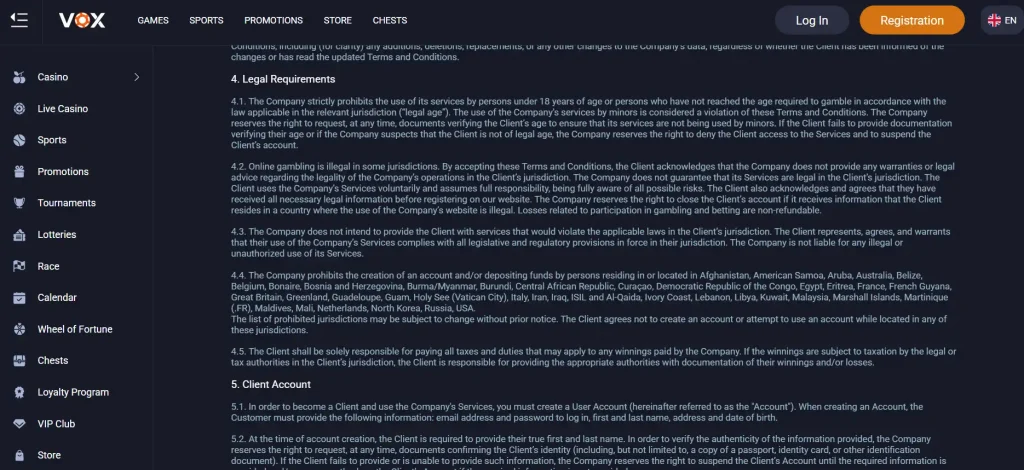
Vox Casino’s published account flow starts with an email address and password, followed by personal details such as first and last name, address and date of birth. Identity checks can then be requested according to transaction activity, risk assessment or other verification needs. For Great Britain, however, the eligibility check comes before every other registration step: the current Vox Casino Terms and Conditions explicitly list Great Britain among the jurisdictions where people residing in or located there are prohibited from creating an account and/or depositing funds. That clause was still visible in the live terms checked on 29 September 2026.
This makes the practical answer different from a generic signup tutorial. The registration form may be publicly reachable, but a visible form shows interface availability, while permission to open and fund an account in Great Britain is governed by the current terms. The current official restriction is therefore the first decision point. The sections below explain the account data Vox publishes, how its KYC policy works, what documents may be requested and why verification can affect access to withdrawals while keeping document requirements account-specific.
Table of Contents
- Great Britain eligibility comes before the signup form
- What information Vox says an account requires
- How Vox describes KYC and verification triggers
- Documents that may be requested
- Payment ownership is part of account verification
- Why KYC can matter at withdrawal time
- Registration data quality: a practical pre-KYC checklist
- What the licence evidence establishes and what remains separate
- What to verify before opening a Vox Casino account
Great Britain eligibility comes before the signup form
The strongest current source is Vox Casino’s own Terms and Conditions. Clause 4.4 states that the company prohibits account creation and/or depositing by people residing in or located in a list of jurisdictions that includes Great Britain. The same clause says the prohibited list may change without prior notice and instructs clients not to create or attempt to use an account while located in one of those jurisdictions.
That distinction matters because registration pages often remain technically visible across both permitted and restricted jurisdictions. A button, form or country selector can show how the site is built, while the contractual eligibility clause remains controlling. For England, Scotland and Wales, the current terms are therefore the controlling Vox-specific evidence for whether account opening is permitted. Northern Ireland is a separate legal term from Great Britain, so the page keeps Vox’s wording tied to the jurisdiction the company actually names.
The terms can change, and Vox itself tells clients to review the latest version. A person considering registration should therefore confirm the live restriction text before entering personal data. This is especially important because a later KYC check can compare identity, address, payment ownership and geolocation-related signals. Attempting to work around a location restriction can create account and payment problems rather than a usable account.
What information Vox says an account requires
The current Terms and Conditions provide a clearer list of registration data than many third-party signup guides. They say an account requires an email address and password for login, plus first and last name, address and date of birth. Vox also states that the name supplied must be genuine and that it may ask for identity documents to confirm the information.
The terms require registration to be carried out personally and restrict the use of another person’s account. They also state that only one account may be created per user and describe controls around shared identifiers such as addresses, devices, payment details and other account signals. The practical lesson is simple: use accurate personal information and payment instruments belonging to the account holder. Registration details serve as reference points for later identity and transaction checks as well as profile information.
The first form should be treated as durable account data. A mismatch between the registered name and the name on a payment method, an outdated address or conflicting identity information can cause additional verification work. Vox’s terms explicitly reserve the right to restrict or close an account where information is false, inaccurate, incomplete or misleading. Careful account setup and KYC therefore form one connected verification process rather than two unrelated stages.
How Vox describes KYC and verification triggers
Vox publishes a dedicated KYC Policy. It frames standard verification as due diligence that may be applied when transaction activity reaches a threshold, when risk assessment identifies elevated money-laundering or terrorist-financing risk, when user behaviour raises concerns about compliance with the terms, or when company personnel consider verification necessary.
The policy describes verification as a risk-based process that can recur at different account milestones. The policy describes a risk-based process. The Terms and Conditions separately authorise checks needed to confirm identity and contact details and say the company may restrict withdrawals during a check. That relationship is important for account planning: verification remains relevant beyond onboarding. It can also become relevant around financial activity and withdrawals.
The policy also describes transaction monitoring. It looks for patterns such as multiple payment cards, rapid switching among payment instruments, resistance to verification, mismatches among location-related signals and connections between devices and other accounts. These examples explain why accurate account details and consistent payment ownership matter. They illustrate risk signals; the outcome still depends on the wider review context.
Documents that may be requested
Vox’s KYC Policy uses the wording “may require” when listing standard verification documents. That wording should be preserved because it means the list is a menu of possible evidence, a menu of possible evidence rather than a guaranteed checklist for every client.
- Identification: a valid government-issued document such as a passport, national ID card or driving licence.
- Payment-card verification: a photo of a card used or intended for deposits, with the cardholder name matching the registered user and sensitive card details masked as instructed.
- Selfie with documents: a photograph of the user holding identification to help confirm authenticity.
- Proof of address: examples given include a utility bill, phone bill or official bank statement issued within the previous three months.
- Financial evidence: in certain cases the policy names bank statements, tax assessment notices or an official employer letter as examples of information that can be requested to understand financial activity.
- Additional or live checks: the policy also allows other documentation based on circumstances and, in some cases, a voice or video call with support.
The official policy presents the six items as possible document categories rather than a universal checklist. The exact request depends on the check being performed. The policy also leaves completion time case-specific. The specific request shown in the account or sent by the operator, together with the latest policy, should govern document handling.
Payment ownership is part of account verification
Verification is closely tied to payments. Vox’s terms say deposits should come from an account, system or bank card registered in the client’s name and that third-party payment instruments are prohibited. The KYC Policy similarly says a payment-card holder name should match the website account owner and describes checks for electronic-wallet ownership.
This means a successful account form still requires payment-method ownership to match the account holder. A common practical error is to think that a relative’s card or another person’s wallet can be used temporarily and corrected later. The current official policies point in the opposite direction: ownership consistency is part of the control environment from the start.
For a broader look at cashier categories, see the site’s payment methods guide. For the point at which verification intersects with payout requests, the withdrawal verification covers method-specific processing issues separately.
Why KYC can matter at withdrawal time
The Terms and Conditions state that Vox may restrict withdrawal of funds while checks are underway. That is a direct reason to treat verification as part of account readiness rather than something to think about only after a large win. If a user has registered with accurate details, kept address information current and used payment methods in the same name, the records needed for a later check are less likely to begin with avoidable inconsistencies.
Verification and payout speed are separate parts of the withdrawal process. Withdrawal timing depends on separate payment and review processes, and exact processing bands can be localised by currency. The important verified connection is narrower: identity checks can be required, and withdrawal access can be restricted during the check period. Any current request shown in the account should take precedence over older interface evidence or a third-party checklist.
Registration data quality: a practical pre-KYC checklist
Even outside Great Britain, where the current restriction may be outside scope, the official policies support a conservative setup routine. Before submitting registration details, a user can check that the name matches government identification, the date of birth is correct, the residential address is current and the email account can actually be accessed. Before making a payment, the account holder should confirm that the payment instrument is in the same name and keep any evidence needed to show ownership.
These steps are practical precautions rather than additional Vox requirements. They are a practical way to reduce mismatches among the data points Vox says it may verify. They also make it easier to understand a document request: identity evidence answers “who is the client”, address evidence answers “where does the client live”, payment evidence answers “who owns the funding method”, and financial evidence can answer risk-based questions about activity or source of funds.
What the licence evidence establishes and what remains separate
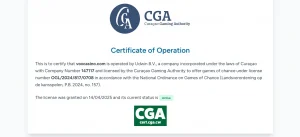
Vox Casino is operated by Udwin B.V. The current Curaçao Gaming Authority certificate identifies voxcasino.com, Udwin B.V., company number 147117, and licence OGL/2024/817/0708 with an active status. That verifies the actual licensing jurisdiction attached to the site.
The Curaçao licence sits alongside the separate Great Britain eligibility clause in Vox’s own terms and remains distinct from a UK Gambling Commission licence. The dedicated licence and trust page explains the regulator distinction and the register check in detail. Keeping these facts separate avoids two common mistakes: assuming that a foreign licence proves Great Britain access, or assuming that the absence of a GB licence tells us anything about unrelated product features.
What to verify before opening a Vox Casino account
For Great Britain, the current Vox Terms and Conditions take precedence over the appearance of the registration button. As checked on 29 September 2026, Great Britain is specifically named in the prohibited-jurisdiction clause for account creation and/or deposits. That makes a conventional “sign up in five steps” sequence inconsistent with the current Great Britain restriction.
For an eligible user elsewhere, the registration and KYC evidence supports a clear sequence: enter accurate personal data, keep account information consistent, use payment methods owned by the account holder, and expect verification to be risk-based rather than identical for every client. If documents are requested, follow the current account instruction and KYC Policy rather than assuming that every possible document category is mandatory. Finally, remember that verification can affect withdrawal access, so account accuracy is part of payout readiness from day one.
The Vox Casino review provides the broader product context; payment methods covers funding, while licence and trust sets out the regulatory position.